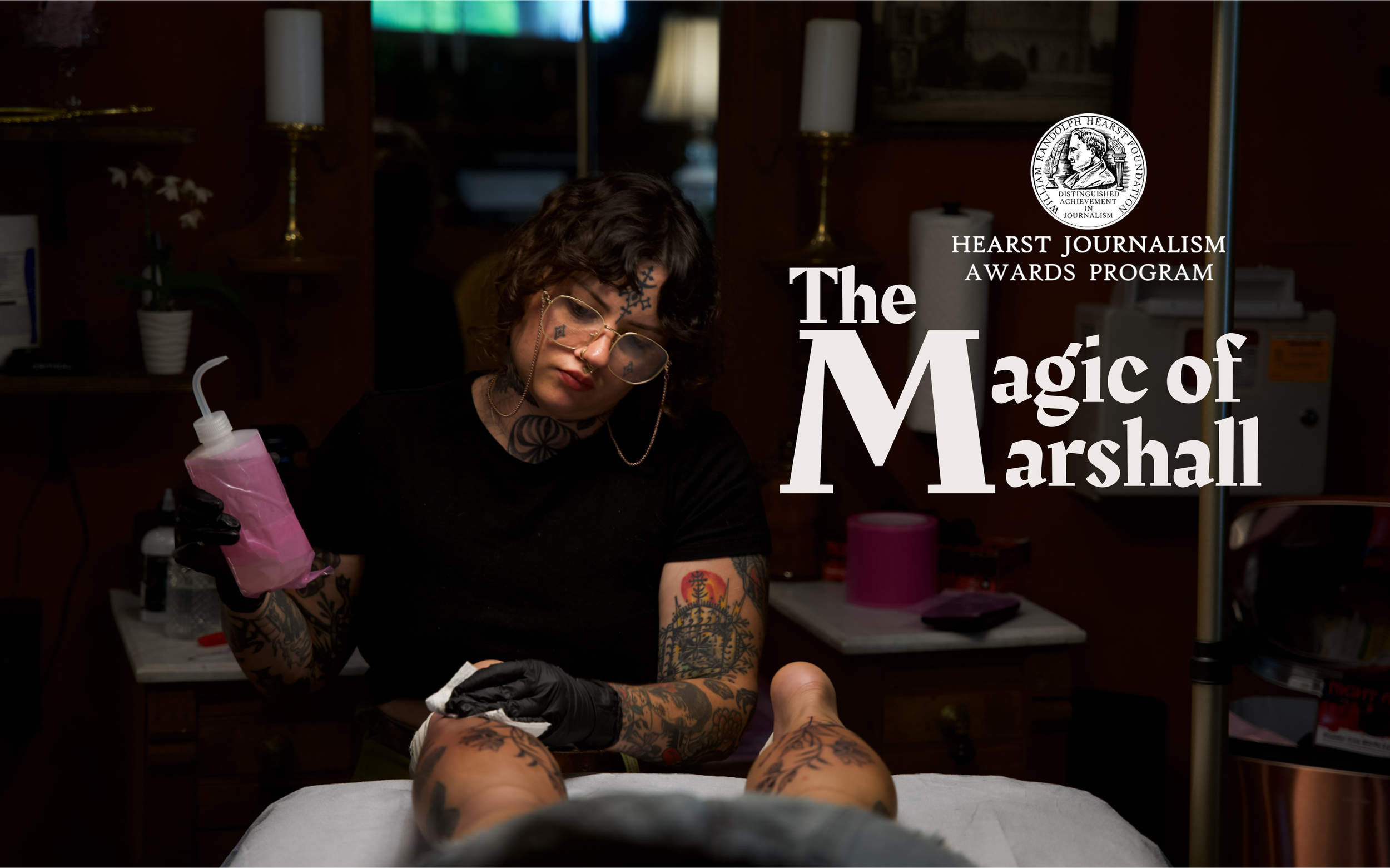
THE MAGIC OF MARSHALL
Marshall, North Carolina sits where the French Broad River — one of the oldest rivers in the world — bends through the Appalachian mountains.
On Sept. 27, 2024, the French Broad River
rose 24 feet in a single day.
108 people across
North Carolina did not survive.
In the French Broad River Valley, Hurricane Helene severed the invisible threads that held communities together. For tattoo artist Baylen Levore, rebuilding meant learning to carry home inside herself.
On the morning of Sept. 27, 2024, Shane Donaldson was in Raleigh, N.C., with his kids when the footage started coming through.
He'd been trying to reach his partner, Baylen Levore, for days. There was no answer or signal. The whole of western North Carolina had gone dark. Roads were washed out or buried under landslide debris. On his screen, the images of the place Shane called home were almost unrecognizable. The town he knew, the river he knew — all of it submerged, broken, brown with floodwater and silt.
"The whole city was just all messed up," he said. "I couldn't get in contact with anyone. I've never really experienced anything like that."
He didn't know if Baylen was alive.
“When I couldn't get in touch with her, I just figured, maybe they're dead or something.”
— Shane Donaldson What Hurricane Helene did to western North Carolina in September 2024 was not supposed to be possible this far inland. The storm made landfall as a Category 4 hurricane on Florida's Gulf Coast, then carved north through Georgia and into the Southern Appalachians, where it collided with a stalled cold front that had already been dumping rain for days. The mountains acted as a funnel, concentrating water and rainfall until some communities received more than 30 inches of rain in under 72 hours.
The French Broad River, which winds north through Madison County past the small town of Marshall, crested at historic levels that surpassed the previous flood record set in 1916 by more than a foot and a half. Nearly 2,000 landslides scarred North Carolina’s western mountainsides. At one point, every road in the region was considered closed to non-emergency travel.
The communities hit hardest by the hurricane weren't cities. They were places like Marshall, built along railroad tracks on the banks of the French Broad, wedged between steep ridgelines with nowhere for the water to go. Every single downtown business was destroyed. Approximately 108 people were killed, 73,000 homes were damaged, and an estimated $60 billion in destruction barreled across communities in western North Carolina that had never once thought to buy flood insurance. Only 0.8 percent of households in disaster-declared counties held policies.
Baylen Levore was in Utah on a camping retreat in Arches National Park when the storm began to take form.
When her plane touched down in Asheville, the storm was venturing toward the Appalachian Mountains. Her father had sent a text: be careful, there's a storm coming. She wasn't worried. She loves storms.
That night, she drove to her tattoo studio on the island in Marshall to grab her iPad and her machines. The studio had flooded before. The other two times, the water only reached the basement.
"I just happened to get out just in time," she said.
What followed were days without power, without phone service, without knowing. When she finally ventured out to look for gas, a neighbor told her flatly: everything is blocked. Marshall is gone. Hot Springs is gone.
"And I was like, whoa, what?" she said. "And I got really scared."
Shane eventually reached her. She was alive, out on the land, living on Gatorade and snack food, unable to leave her home for days.
___________
Baylen had found Marshall the way most people find the things that matter most: accidentally, through someone else's passion. She came for the handmade market held inside the town's historic high school building, a converted space of tall windows, warped old glass, and creaking wooden floors. She walked in and knew immediately she was going to tattoo out of that building.
"I don't know if they'll let me," she remembered thinking. "But I'm going to try."
They let her. She signed a lease for a room, and over six years, she built something she called Pars Fortuna — a studio so layered with plants, antique lamps, crystal prisms and curated artifacts that clients described it as a classroom in Hogwarts. She and her co-tenant spent weeks sanding a wall down to reveal its many layers of paint from the building's former life as a school. The wall looked, people said, like a treasure map.
Baylen specializes in black and gray, historically influenced work drawing from art history and occultism. People came to get tattooed, and many of them cried. A massage therapist explained to her later that the
mid-back holds emotion, and tattooing that spot releases it. Baylen and her studio mate made shirts: I Cried at Pars Fortuna. They sold out.
“It wasn't just a place where I worked. It was like a home.”
— Baylen Levore Marshall was that, too, for Baylen and for the rotating cast of old-timers, young punks, bluegrass musicians, artists, witches and craftspeople who had made the French Broad Valley their unlikely home.
"The French Broad is one of the oldest rivers in the world," she said. "These Appalachian mountains [are] one of the oldest mountain ranges. It just feels like a place where you can tap into something older than yourself."
Then the river rose 24 feet in a single day, and took most of Marshall with it.
Marshall, 2012–2025.
When Baylen finally made it back to the island after the flood, the building was tilted. A sliver of floor remained walkable across the main room, above inches of toxic mud. She broke into her own studio with a fire extinguisher, cut her finger badly on the glass and nearly passed out face-first into the contaminated muck. Her friend held her up.
They couldn't get to a hospital. A friend drove them through the woods to a woman who does street medic first aid. She stitched Baylen’s finger in a living room full of crying people, beside a pet deer named Maggie.
“It was an extremely post-apocalyptic vibe.”
— Baylen Levore Shane came up a week later to help gut the studio building. The whole place was already covered in white fuzzy mold, the smell almost unbearable. Dog food and animal rescue supplies from a neighboring unit were mixed in with the mud and debris.
"It was so crazy how fast it happens," he said. "Everything was just — yeah. It was terrible."
Later, after volunteers had cleared her studio, Baylen went back one last time. In the empty back room, two tarot cards were plastered to a window — the only survivors from a box of hundreds. The Eight of Swords: a bound woman whose restraints, if you look closely, are loose enough for her to remove herself. And the Star: the card of new beginnings that follows the Tower, the card of destruction.
"I feel like anytime I go through something really crazy, there's like weird stuff that happens," she said. "And I kind of like to see it as my spirits or ancestors giving me a little sign of hope.”
Pars Fortuna (above), Baylen Levore's tattoo studio inside Marshall High Studios on the island in Marshall, N.C., in November 2023, roughly a year before Hurricane Helene destroyed the space. Photo courtesy of Baylen Levore.
The same space inside Marshall High Studios (below) in Marshall, N.C., on May 12, 2025, after Hurricane Helene flooded the building in September 2024. The studio has since been gutted and partially restored.
“I’m starting to become a solid being again.”
— Baylen Levore
The high school building has been partially restored. There’s new subfloor in Baylen's old studio — concrete poured into the great tilted pit of the main room. She went back recently for the first time since the flood.
"They're going to flood again, for sure," she said. "But at least it's concrete now."
Baylen didn't go back to stay. Pars Fortuna reopened in a new space, away from the island, away from the river. She says tattooing there has given her a second wind. She experiences less burnout than before and more excitement than she's felt in years. Her other business, Calamus & Honey, a folk magic and occult goods shop she co-owns with her friend Jonathan on Haywood Road in Asheville, became an impromptu community hub during the outages. It mysteriously retained electricity while much of the neighborhood went dark, offering coffee and phone charging to anyone who needed it.
And on days off, she plays baseball with Asheville Vortex Baseball, a ragtag community team.
"It makes me feel like a child," she said. "And it's really saving me right now."
Baylen describes her current state the way she once described the feeling of her old studio: liminal. In between. Before the storm, she had been feeling stuck like a caterpillar in a cocoon, liquefying before it transforms.
"I am starting to become a solid being again," she said. "It's not there yet. There's still some transforming to do. But I think it's getting there."
Marshall is getting there too. Construction zones dot where bars once stood. Businesses are reopening before they're probably ready. Old-timers and young punks continue to share a beer, even in the rubble.
"I just want people to know that Marshall is still a very special place," Baylen said. "It's going to be really special and great again one day. It still is."
Shane agrees. He went back too — to help, to see, to make sure the place he watched disappear on a screen in Raleigh was still, somehow, there.
It is. Just not the same.
Baylen Levore plays with her daughter in the woods near her home in the French Broad River Valley, N.C., on May 13, 2025.
Produced by Amelie Fawson.
Visit Floodlines here.